Why Your Small Business Website is Failing (And How to Fix It in 2026)
Many owners fall into the trap of thinking that simply having a small business website is enough for growth. Unfortunately, in 2026, a static, unoptimized site is less of an asset and more of a digital anchor.
The harsh reality is that 80% of business sites underperform because they lack a clear strategy, rely on generic messaging, and suffer from poor conversion paths. Your website should be your hardest-working employee, not a digital brochure that collects dust.
A website cannot fix broken business fundamentals. If your offer lacks market demand or your financial model is unsustainable, no amount of web design will save you. A site only amplifies what you already have.
Is Your Site Too Slow to Function?
The mobile web is a high-stakes environment where every millisecond costs you money. In a Q1 2026 audit of 292 small business websites, a staggering 96.9% failed to meet basic mobile speed standards.
Google uses Core Web Vitals to measure the health of your site. When your Largest Contentful Paint (LCP) or First Contentful Paint (FCP) numbers are poor, Google effectively hides your site from search results. More importantly, real human users leave within seconds if they don't see content immediately.
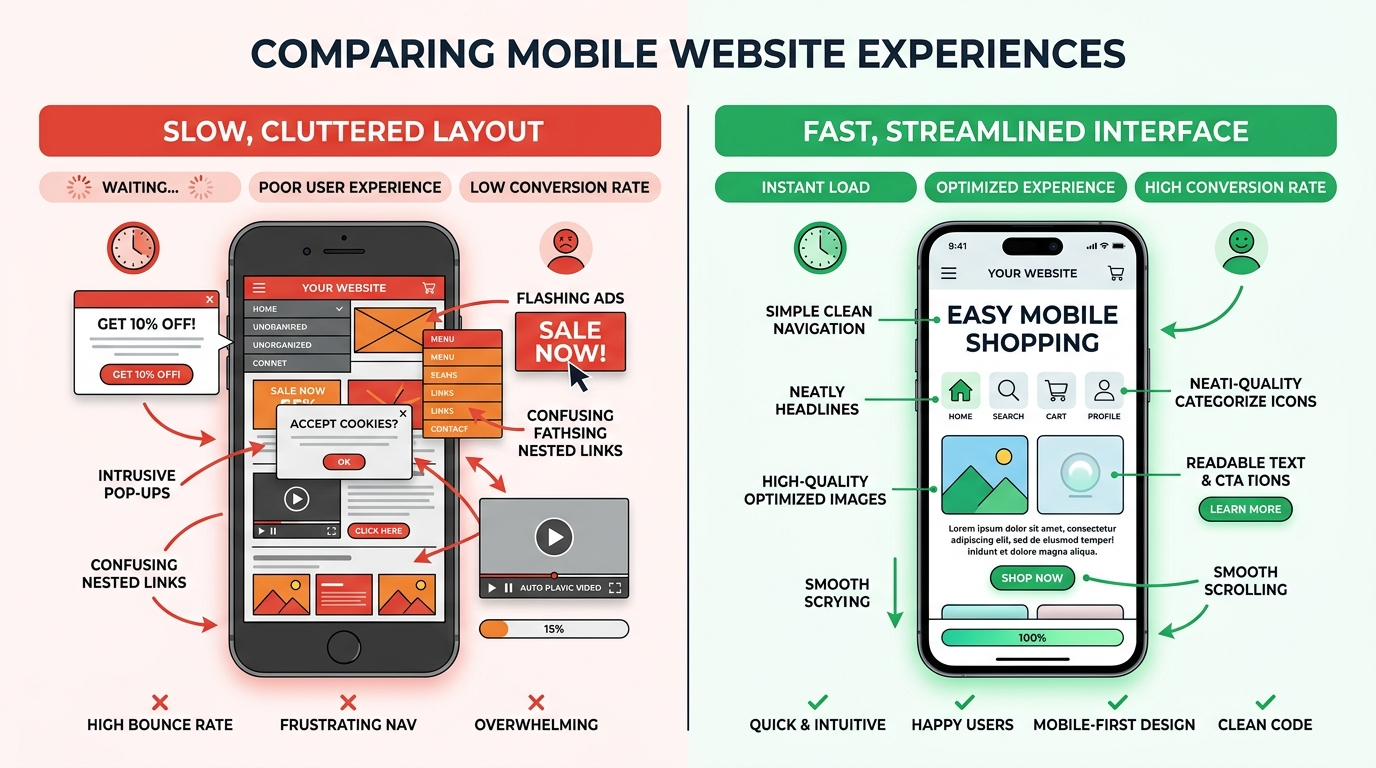
If you haven't prioritized mobile website speed optimization, you are actively paying to send customers to your competitors. Speed is no longer a "nice-to-have" feature; it is the baseline for digital survival.
Run a performance audit today. Use tools like Google PageSpeed Insights. If your mobile score is in the red, focus on compressing your images, minimizing render-blocking scripts, and simplifying your mobile menu structure.
The Hidden Cost of Ignoring Accessibility
There is a persistent myth that website accessibility is only for massive corporations or a tactic to avoid legal trouble. This mindset is costing you revenue.
Recent research shows that 100% of evaluated small business sites failed basic "Link Label" accessibility checks. When your buttons just say "Click Here" or your navigation is confusing, screen readers and frustrated customers both get lost.
Improving website accessibility isn't just about compliance; it is about usability. When you design a site that is easy to navigate for users with disabilities, you inherently create a better, more intuitive experience for every single visitor.
Messaging: Are You Confusing Your Customers?
Does your website speak in "corporate-speak" or "customer-speak"? If your homepage is full of vague promises about "synergy" or "solutions," you are losing leads.
Your visitors have three questions: What do you do? How does it make my life better? How do I get it? If they can’t answer these in five seconds, they will leave.
- Define your offer clearly: Your H1 headline should state exactly what you do for the customer.
- Focus on the transformation: Stop listing features and start highlighting the problem you solve for the client.
- Align with strategy: Your web copy should be a direct reflection of your business goal, whether that’s lead generation, e-commerce, or service bookings.

Turn More Visitors Into Leads (The Automation Gap)
Successful 2026 brands have moved past the "brochure site" model. They understand that a website should be an interactive engine that functions 24/7, even while you sleep.
If your site has no way to capture information or nurture interest, you are losing potential revenue. Integrating AI-powered chat and automated lead follow-up workflows allows you to engage prospects the moment they show interest.
Trust signals are mandatory. You cannot expect someone to hire you without proof. Ensure you prominently feature case studies, verified reviews, and clear guarantees to reduce friction during the buying process.
Your 2026 Action Plan: How to Start Fixing Your Site
You don't need to overhaul everything overnight, but you do need to stop guessing. Start by fixing your technical foundation and then iterate on your messaging.
Follow these three steps to begin your digital strategy turnaround:
- Audit your mobile performance: Identify which pages are failing Core Web Vitals and address the biggest bottlenecks first.
- Map your conversion paths: Look at your analytics. Where are users dropping off? Ensure every page has a single, clear, high-contrast call-to-action button.
- Simplify your copy: Strip away the fluff. Test a headline that clearly states your primary offer and see if your lead volume changes.
Frequently Asked Questions
Why is my mobile site still slow even if it looks good?
Most sites are slowed down by "bloat"—heavy, high-resolution images, too many third-party plugins, and unoptimized tracking code. A site can look beautiful on a high-speed desktop but fail completely on a mobile network due to inefficient background code.
How do I know if my website messaging is confusing?
The "Five-Second Test" is the gold standard. Ask a friend or a customer who isn't familiar with your business to look at your homepage for five seconds. If they can’t explain exactly what you offer and why they should care, your messaging needs to be simplified.
Is automating leads through a website too expensive?
Absolutely not. In 2026, tools like AI-driven chatbots and automated email responders are more affordable and easier to integrate than ever. Investing in these tools often pays for itself quickly by capturing leads that you would have otherwise missed.
Ready to stop losing money on your current site? Let's take the guesswork out of your growth. Book a free audit call with CodeRift today and let’s see where your site is losing potential customers.